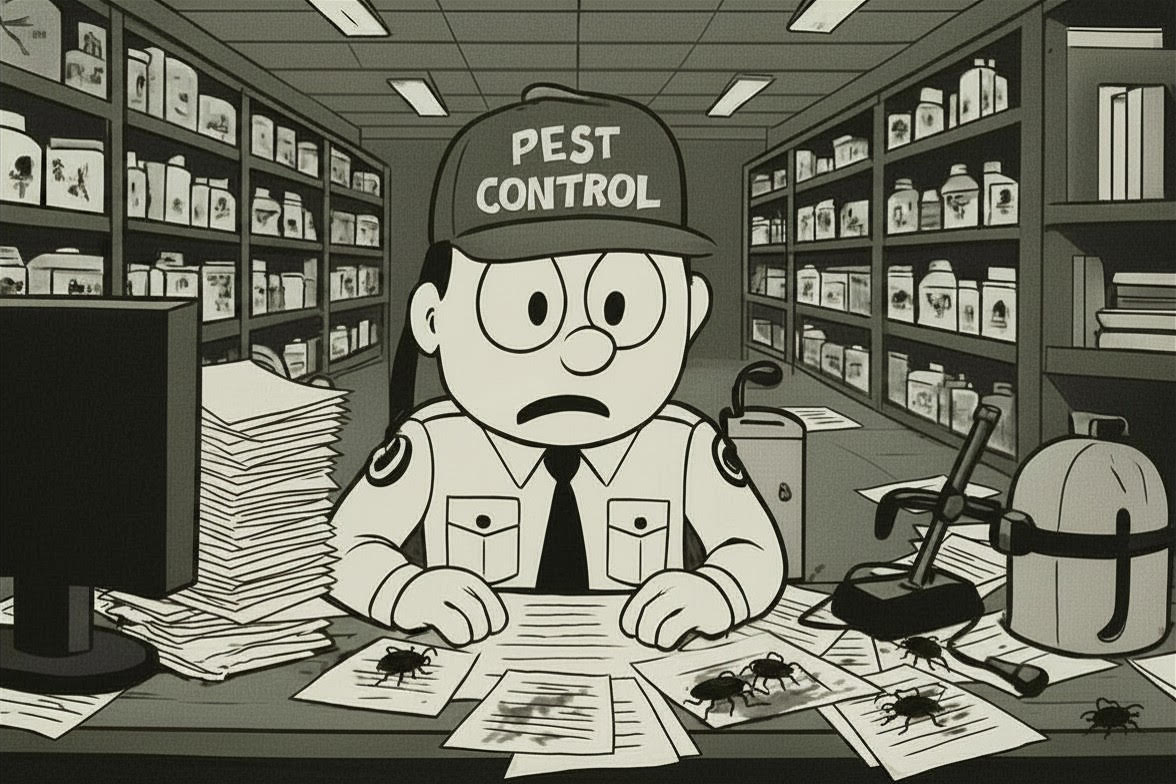
If you don't work in pest control, you might not know that licensed operators are already working in one of the most heavily regulated professions around, governed by an interlocking web of state and federal rules that dictates what they can use, where, when, and how they have to document all of it. This is the least fun part of being a pest control operator, and it does not look like it is going to get better anytime soon.
How Pesticide Regulation Works
In the United States, pesticides are registered and regulated by the Environmental Protection Agency (EPA) under the Federal Insecticide, Fungicide, and Rodenticide Act (FIFRA). Before anything can be sold or used, the EPA must find that it will not cause unreasonable harm to people or the environment. That approval is not a lifetime membership. The EPA reviews products on an ongoing basis, and a chemistry that sailed through in one decade can fail the next one as the science catches up.
California then adds its own layer. The California Department of Pesticide Regulation (DPR) runs its own review system and can impose restrictions stricter than the federal floor. Crucially, DPR reviews concurrently with the EPA instead of politely waiting its turn, so California tends to move first. And because California is the largest pesticide market in the country, where California goes, the rest of the country usually follows a few years later.
What Operating Under These Rules Actually Looks Like
To apply pesticides commercially, an operator needs licenses from two separate state agencies — the Structural Pest Control Board for work in and on structures and DPR for pesticide use more broadly. Two agencies, two licenses, two offices, one operator trying to keep it all straight.
Just becoming a Branch 2 Operator, the license that lets you actually run a pest control company, takes two years and at least 3,200 field hours, one of those years as a licensed Field Representative, plus board-approved coursework in pesticides, pest biology, contract law, regulations, and business practices before you can even sit for the exam.
Only then do you earn the right to do reams and reams of paperwork. Structural operators must file a monthly pesticide use report in every county they work in. If they did no pest control at all that month, they still must file a report saying so — the bureaucratic equivalent of confirming you have nothing to confirm.1 Work across five counties and you are running five separate reporting relationships at once.
And that is before the product-specific rules. Restricted-use pesticides need their own permit to even purchase. Some come with site restrictions spelling out exactly where and how they can be used. The label is a legal document and using a product in any way it does not describe is a federal violation. So, every time a product gets restricted, every operator relying on it must find a replacement, rewrite their protocols, retrain their staff, and update their filings. This slow, tedious, costly process is happening more and more often.
What Has Actually Been Restricted
Neonicotinoids are the clearest recent example of how fast the ground can move. Commonly called neonics, they are synthetic insecticides that latch permanently onto an insect's nerve cells. Exposed insects shake uncontrollably, become paralyzed, and die.2 Introduced in the mid-1990s, they went on to become some of the most widely used insecticides on the planet across farms, landscapes, and homes. DPR started formal rulemaking on neonics in 2022,3 and California followed with AB 363, which took effect in 2025. New York, New Jersey, and Nevada, among others, have all moved the same direction,4 and the EPA's own review of the class suggests more is coming.
If restriction is the stick, biopesticides are the carrot — and Yeast Bay Bio is aiming to be the ultimate carrot. Biopesticides clear registration far faster than conventional chemistry. The EPA registers many in under a year, against an average of more than three years for conventional pesticides.10 Since January 2025 alone, fifteen new biopesticide active ingredients have been registered.11 The system is being deliberately tuned to move innovation this way.
| Conventional pesticide | Biopesticide | |
|---|---|---|
| Avg. registration time | 3+ years | 1 year |
| Regulatory trend | Restriction | Encouragement |
| Market growth (annual) | Low single digits | 10–20% |
The Direction Is Set, and It Has a Deadline
None of these restrictions are happening in a vacuum. They are pieces of a stated, published policy direction. For decades the baseline has been Integrated Pest Management (IPM), the principle of reaching for the least toxic effective option first.5 California is now building something more ambitious on top of it.
In 2023, the state released a roadmap that set two goals for 2050 — eliminate priority high-risk pesticides and make Sustainable Pest Management (SPM) the default system statewide.6,7 SPM extends IPM by folding in human health, environmental protection, and economic vitality.
"The state did not just quietly retire one chemical and hope nobody noticed. It published a map, marked the destination, and circled a date in red marker."
This is the part operators should not miss. The pesticides on the chopping block are the ones flagged for significant harm to people or ecosystems, with DPR deciding which ones based on hazard, risk, and whether a viable alternative exists.6 Translation: the highest-risk tools are on their way out, and whatever can replace them is being waved through.
For cockroach control specifically, this is not hypothetical. The two chemistries the professional industry leans on most are already squarely in DPR's sights. Fipronil, the active ingredient in many of the gel baits that anchor cockroach programs, has been flagged by DPR as a contaminant of concern, detected in roughly half of urban surface water samples at concentrations that exceed federal aquatic-life toxicity thresholds.8 The pyrethroids, the workhorse spray class, turn up so consistently in urban waterways that DPR has already imposed surface water regulations to rein them in.9 The regulators are not coming for some distant exotic chemistry. They are coming for the contents of the average cockroach technician's truck.
What This Means for Yeast Bay Bio
Yeast Bay Bio is based in California, which is not a geographic accident. Building in the state with the strictest pesticide review in the country, in conversation with the agency that sets the tempo for everyone else, means we are designing for where the rules are heading rather than where they have been.
RNA interference is a genuinely different process. It works through a biological mechanism that has nothing to do with neurotoxic chemistry, hits the target species and leaves everything else alone, and breaks down in the environment instead of lingering for months. It is not a new spray to swap into the old can. It is a different way of thinking about the problem entirely.
The state has already told everyone where this is going. The only open question is who builds the tools that get the industry there, and that is the question Yeast Bay Bio exists to answer.
- California Department of Pesticide Regulation. Structural Pesticide Use Report (PUR) Policy, Enforcement Letter ENF 16-26. October 19, 2016. https://www.cdpr.ca.gov/?p=6382
- UC Agriculture and Natural Resources. Neonicotinoid Pesticides No Longer Available. January 2025. https://ucanr.edu/node/116197
- California Department of Pesticide Regulation. Notice of Formal Rulemaking on Neonicotinoid Restrictions. February 25, 2022. https://www.cdpr.ca.gov/?p=3817
- DIY Pest Control. How California's Neonics Restrictions Will Affect Pest Control and Consumers. December 2024. https://diypestcontrol.com/blog/how-californias-neonics-restrictions-will-affect-pest-control-and-consumers.html
- California Environmental Protection Agency. California Unveils Bold Plan to Sustainably Manage Pests and Eliminate High-Risk Pesticides by 2050. January 26, 2023. https://calepa.ca.gov/…/press-release
- National Agricultural Law Center. California Takes Steps to Reduce Pesticide Use In State. January 18, 2023. https://nationalaglawcenter.org/…
- California Department of Pesticide Regulation. SPM and IPM Overview. https://www.cdpr.ca.gov/docs/sustainable_pest_management_roadmap/
- California Department of Pesticide Regulation. Fipronil Monitoring and Model Scenarios. 2016. https://www.cdpr.ca.gov/report/fipronil-monitoring-and-model-scenarios/
- California Department of Pesticide Regulation. Study 320: Ambient Surface Water and Mitigation Monitoring. 2025. https://www.cdpr.ca.gov/…/study_320_sampling_plan_wy25-26.pdf
- U.S. Environmental Protection Agency. What Are Biopesticides? https://www.epa.gov/…/what-are-biopesticides
- U.S. Environmental Protection Agency. EPA Announces Proposed Registration of New Biopesticide. October 23, 2025. https://www.epa.gov/…/epa-announces-proposed-registration-new-biopesticide
- Market Research Future. Biopesticides Market Size, Share, Trends, Growth, Analysis by 2035. 2025. https://www.marketresearchfuture.com/reports/biopesticides-market-5098
- Marrone, P.G. Increasing the use of biological pesticides in integrated pest management programs. Frontiers in Insect Science, Volume 5, 2025. https://doi.org/10.3389/finsc.2025.1552361