Conventional pest control kills from the outside in. A poison contacts the insect and attacks its nervous system, and because nervous systems across the animal kingdom are built from the same basic parts, a chemical that scrambles a cockroach's nerves can also harm a bee, a fish, a dog, or a person given enough exposure. That is the trade-off baked into conventional chemistry. The thing that makes it deadly to the pest is the same thing that makes it risky to everything else.
RNA interference (RNAi) kills from the inside out, and it does so in a way that can only ever affect the target. To understand it, it helps to start with what RNA actually is.
Okay but RNA You a Little Curious?
Think of DNA as the master blueprint stored in a cell's library. RNA is different. RNA is a temporary working copy of specific instructions.
When a cell needs to make a protein, it creates an RNA copy of the relevant DNA section. That RNA travels out of the cell's library and instructs the protein-making machinery to assemble the protein in the correct order. Once the protein is built, the RNA breaks down naturally. Cells are constantly making new RNA and breaking down old RNA. It is a temporary message system, not a permanent record.
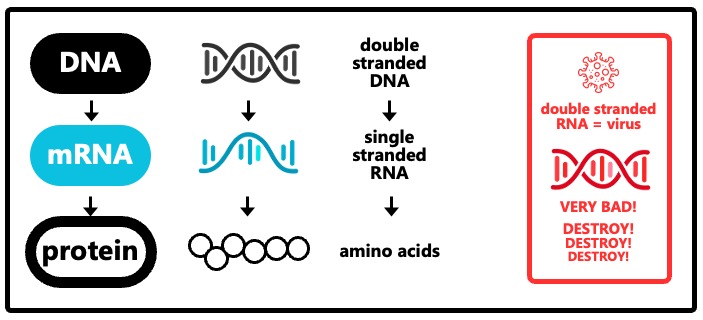
RNA is temporary by design. It works, then degrades. This is why it doesn't bioaccumulate in the environment, and also why it needs protection during delivery.
Nature's Off Switch
Here is the part that makes our approach possible. Sometimes a cell needs to destroy RNA rather than read it, and the clearest example is a viral infection. When viruses invade, many of them flood the cell with their own RNA. Cells evolved to recognize this as a danger signal, and when they detect it, a molecular alarm goes off that essentially says VERY BAD, DESTROY, DESTROY, DESTROY. The cell's machinery then hunts down that RNA and any matching instruction and chops it up before it can be used.
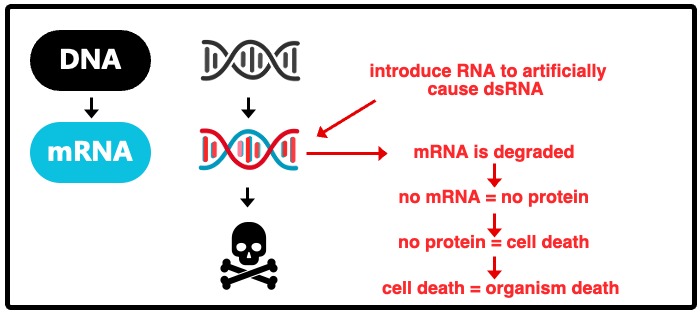
Scientists did not invent this. It is a natural defense mechanism cells already rely on, and figuring out how it works won the Nobel Prize in 2006.1 It has since become one of the most studied processes in modern biology. The mechanism has a tidy nickname, RNA interference, or RNAi, because the incoming RNA interferes with a specific instruction and silences it.
This is exactly the defense mechanism Yeast Bay Bio puts to work. When a cockroach consumes our yeast, its cells detect the RNA signal inside and react as if fighting an infection. The alarm goes off, the cell's defenses activate, and they destroy the matching instructions. Those instructions happen to be the cockroach's own directions for making proteins it cannot live without. No instruction, no protein. No protein, the cell fails. Enough cells fail, and the insect dies, killed from the inside out by an instruction it ate.
Why That Matters for Safety
The crucial detail is the matching. RNAi only silences an instruction whose sequence matches the signal. It is less like a poison and more like a search term. If the letters do not match, nothing happens.
This is where the biology does something chemistry cannot. Because RNAi only acts on a genetic match, we design our RNA to match something that exists only in the target pest and nowhere else. A German cockroach and a honeybee are both insects, but at the genetic level they are wildly different, separated by hundreds of millions of years of evolution. A sequence built to match a cockroach has no counterpart to grab onto in a bee, a butterfly, a fish, a pet, or a person. There is no matching instruction to chop up, so nothing happens.
The safety is not a warning printed on a label or a precaution you take during application. It is a direct consequence of how the molecule works. The selectivity is built into the biology.
Why Yeast?
Knowing RNAi exists is one thing. Getting the right RNA into the right insect, intact, is the hard part. RNA on its own is fragile and does not survive the journey through an insect's gut.
Our answer is yeast. Specifically, Saccharomyces cerevisiae, ordinary baker's yeast, the same organism humans have used for thousands of years to make bread, beer, and wine. It is one of the most well-understood and industrially optimized organisms on the planet, and it happens to be the perfect package for our RNA. We engineer the yeast to carry the RNA we want, then heat-kill it so nothing living is ever released. The yeast cell protects the RNA on the way in and delivers it where it needs to go. Many structural pests, including cockroaches, already eat yeast happily, so the bait does not have to fight to get taken.
Using yeast as both the RNA factory and the delivery package is what makes this work. It is an edible, shelf-stable capsule built by one of the cheapest, safest, best-understood organisms in industrial biology.
Putting It Together
Conventional insecticides work by being broadly toxic and hoping the dose lands mostly on the pest. RNAi works by being precise, a tool that does nothing at all unless it finds its exact match.
That single difference is why the safety profile is not a feature we added. It is the biology itself. We did not make a poison less dangerous. We built something that was never broadly dangerous to begin with, because it can only act on the one thing it was designed to find.
Lethal to the one insect it was designed for,
harmless to everything else.